Thursday, June 21, 2018

Native Orchids of West Virginia

The last couple of days I have had opportunities to revisit areas with very nice West Virginia Orchids.
          On a woodland road run near my home, I paused to crawl under some Rhododendron against a creek and find Appalachian Twayblade. I found this here a couple years ago but it is still not reported to be found in this county (Raleigh). Listera smallii on USDA Web Site.


Appalachian Twayblade


Appalachian Twayblade


After a conference in Morgantown, I drove over to the Canaan Valley area to spend a night and hike in the West Virginia Highlands. It was early for some of the flowers I was searching for but a lot of wildflowers were early this year and I was not disappointed on this trip.
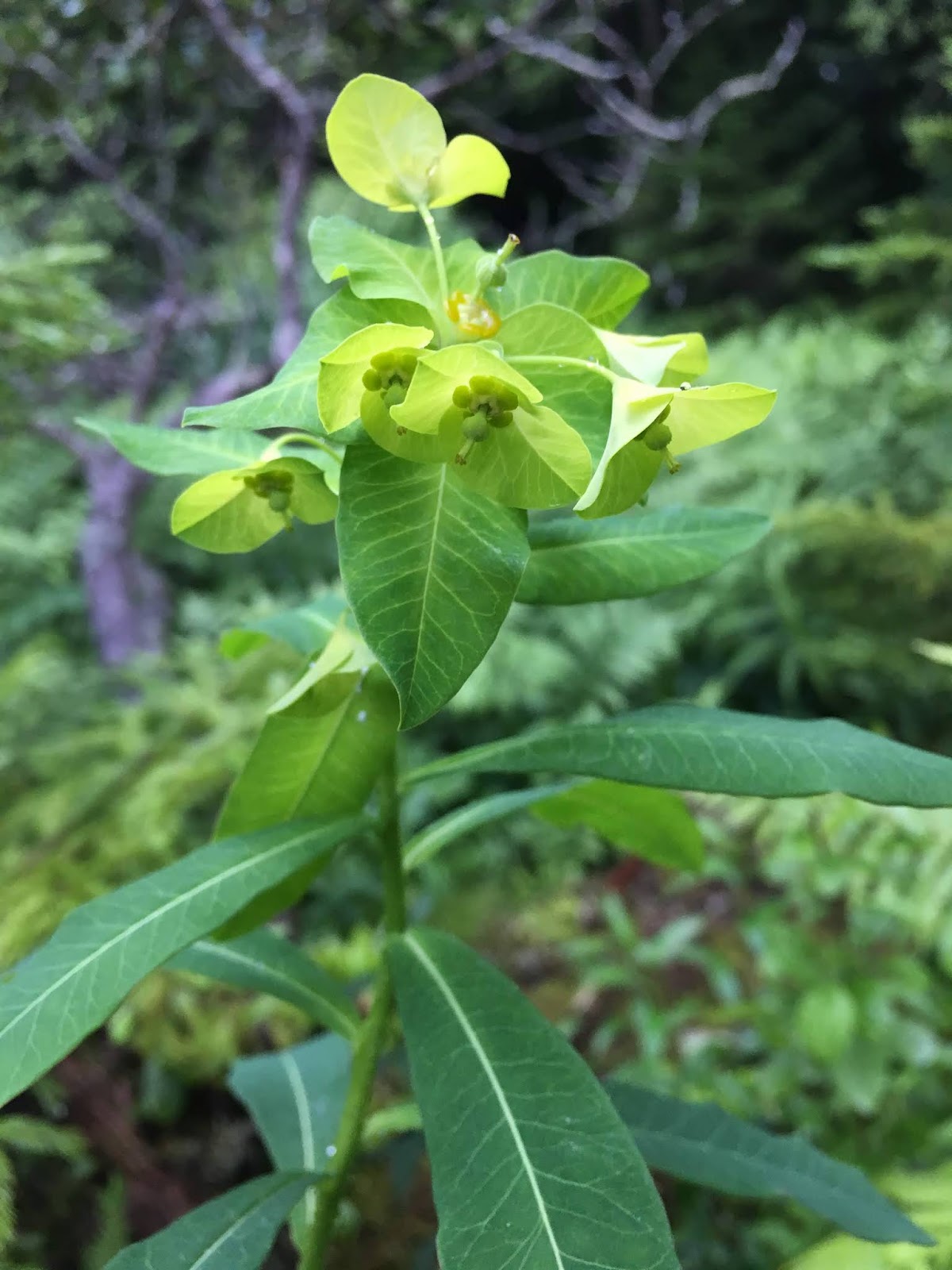
First it was to a bog area where one of the two West Virginia populations of Showy Lady Slippers are located. They were in great shape and I also saw a couple of globally rare plant wild flowers, Appalachian Jacob's ladder and Glade Spurge. Purple Fringed Orchid and Woodland Sorrel .
            After one storm and while thunder rumbled, I hiked into the  bog with ankle deep water and took the following pictures 

Showy Lady Slipper


Purple Fringed Orchid


Glade Spurge


Spruce Knob (One-sided red spruce deformed by constant exposure to strong westerly winds cling to the high rocky ridges)


My next stop was at Spruce Knob. At 4863 feet in elevation, 
this is the highest point in West Virginia. This was my first
 visit and I hoped to find some leftover Spring Ephemeral. 
As I drove up the access road the temperature dropped 10 degrees and the sun was replaced by fog and wind.   


Appalachian Jacob's Ladder 


#361-Wild Bleeding Heart Spruce Knob
, another new West Virginia wildflower for my attempt to photograph
and record every wildflower that I can in West Virginia.


Columbine


       #362-Bunchberry Dogwood, Spruce Knob
Another new West Virginia wildflower for my attempt
to photograph and record every wildflower that I can in West Virginia.


 My last stop was the Cranberry Glades Botanical area. I usually go there around July 4th but since everything is early this year, I made the trip there. I was rewarded with several more Orchids and wildflowers
Grass Pink Orchid Cranberry Glades


Rose Pogonia-normal coloration Cranberry Glades
Rose Pogonia- almost white Cranberry Glades 


Grass Pink  Cranberry Glades 


Sundew with captured insect Cranberry Glades


White Monkshood Cranberry Glades


Cranberry Flower- Namesake of botanical area

Sunday, June 3, 2018

Early Summer and Orchids

No church services this Sunday afternoon, so I took the opportunity to visit a favorite of mine. One of the two populations of Showy Lady Slippers in West Virginia. You can read about previous visits here:
https://wvnativeflowers.blogspot.com/2013/06/showy-ladys-slippers-and-others.html
https://wvnativeflowers.blogspot.com/2016/06/june-orchids.html
So, I drove almost 80 miles and hiked into the woods and ran into a group of people from my community. We all knew the same people and enjoyed each others company at the Showy Lady Slipper site and shared stories.
The weather was great and the flowers in full bloom. One of the groups members even found Lily-Leaved Twayblade; the second location that I'ver seen it. Below are several pictures from the day.
Showy Lady's Slipper (Cypripedium reginae)

Almost White Showy Lady's Slipper


Monday, April 16, 2018

April Showers (Snow Showers That is)

Been on a couple nice hikes between snowstorms. Warm weather a few days and then snow. 
It rained yesterday and now is snowing again. Seen a lot of familiar wildflowers and I post 
them each year as sort of timeline to compare and contrast bloom times. All of these except 
the Fumewort, were from New River- Near Glade Creek


Trout Lilly


Cut-leaf Toothwort
Squirrel Corn


Purple Trillium

Carolina Spring Beauty

Dutchmen's Breeches 


Phlox

Large Flowered Bellwort

Yellow Fumewort (Harrison County)

Dwarf Larkspur 

Mitrewort

Hepatica 

Monday, March 5, 2018

In winter, I plot and plan. In spring, I move. H. Rollins

Bluebells 
And so it begins. Ephemeral season has started early this year. With four years of data from this blog, I can see this is the earliest that I have found Hepatica and Bluebells. I was out running today on Glade Creek Road and Trail today and kept a eye on the road and trail sides during a six mile run. This is my favorite ephemeral location and I had only faint hope of seeing anything. First it was the Hepatica, Liverwort. It has many color variations and the first was white then blueish and finally a pink and white one. On up the trail I found Bluebells just beginning to open and a sedge that was in bloom. This week is calling for colder weather, snow and and a variety of winter weather so it was good to see these wildflowers. So, the rush begins; I have several locations that I call my favorite location and several that I want to get to this spring. So, I'll be busy, but loving every minute of it.
Hepatica-Interesting White and Pink Color
Slightly Blue Hepatica


Slightly Blue Hepatica


Sedge

White Hepatica

Monday, February 26, 2018

February Warm Day Blooms

One of the advantages of keeping a blog like this is that I now have four years of data showing weather trends and bloom times of many wildflowers. While looking through the past four February posts, I noticed that there were almost no blooms, wildflower or domestic. While I noted some warm trends, most of the time it was March before I commented on the first Crocus or Spring Peepers. This year, I saw Crocus at my 3050 foot elavation home on February 23rd and the first Daffodils were today.
I heard the first Wood Frogs peeping on February 21st just across a field from my home. We have had two weeks of beautiful 60-70 degree days and a lot of rain. A lot of spring emerging flowers and animals are starting early, but I am afraid they are in for a surprize. Tonight it will be 28 degrees and the trend is cooler into the weekend


And I saw my first new wildflower of the year for my attempt to photograph and record every wildflower that I can in West Virginia. I had saw a Facebook post about American Hazelnut blooms, so I checked the ones near my home. And, they were there..... Tiny and very pretty. But, so small, it explains why I have overlooked them until now. So it makes 360 wildflowers I have found and photographed in West Virginia, and I probably have many to go....I hike many miles looking for something new, chase leads from many sources and do a lot of research to find these flowers. Most are native but many are not. But I record them if they are now a part of the landscape of West Virginia. 


# 360 - American Hazelnut
(male flowers in catkin)
# 360 -American Hazelnut
(female flower)


In winter, I plot and plan. In spring, I move. Henry Rollins

Sunday, October 8, 2017

Early Fall 2017

Just a few wildflowers and other stuff from some recent walks around the farm or close by.
One new wildflower for my attempt to photograph and record every wildflower that I can in West Virginia. Mistflower, a member of the Aster family.
Wildflower season is quickly coming to a close.
# 359 - Mistflower Conoclinium coelestinum

                    Collinsonia canadensis    

           Citronella horsebalm, Richweed, Stoneroot


Yellow Jewelweed

Native Brook Trout "Brookie"
Catch and Release

Grandson enjoying the Hanging Rock Raptor Observatory 
Looking for raptors after a long uphill hike

Sneezeweed

Nodding Ladies Tresses

Pawpaw in Fall colors
 “GATHERING LEAVES
Spades take up leaves
No better than spoons,
And bags full of leaves
Are light as balloons.
I make a great noise
Of rustling all day
Like rabbit and deer
Running away.
But the mountains I raise
Elude my embrace,
Flowing over my arms
And into my face.
I may load and unload
Again and again
Till I fill the whole shed,
And what have I then?
Next to nothing for weight,
And since they grew duller
From contact with earth,
Next to nothing for color.
Next to nothing for use.
But a crop is a crop,
And who's to say where
The harvest shall stop?” 
― Robert Frost